
Quantum-Safe Cryptography for Financial Transactions
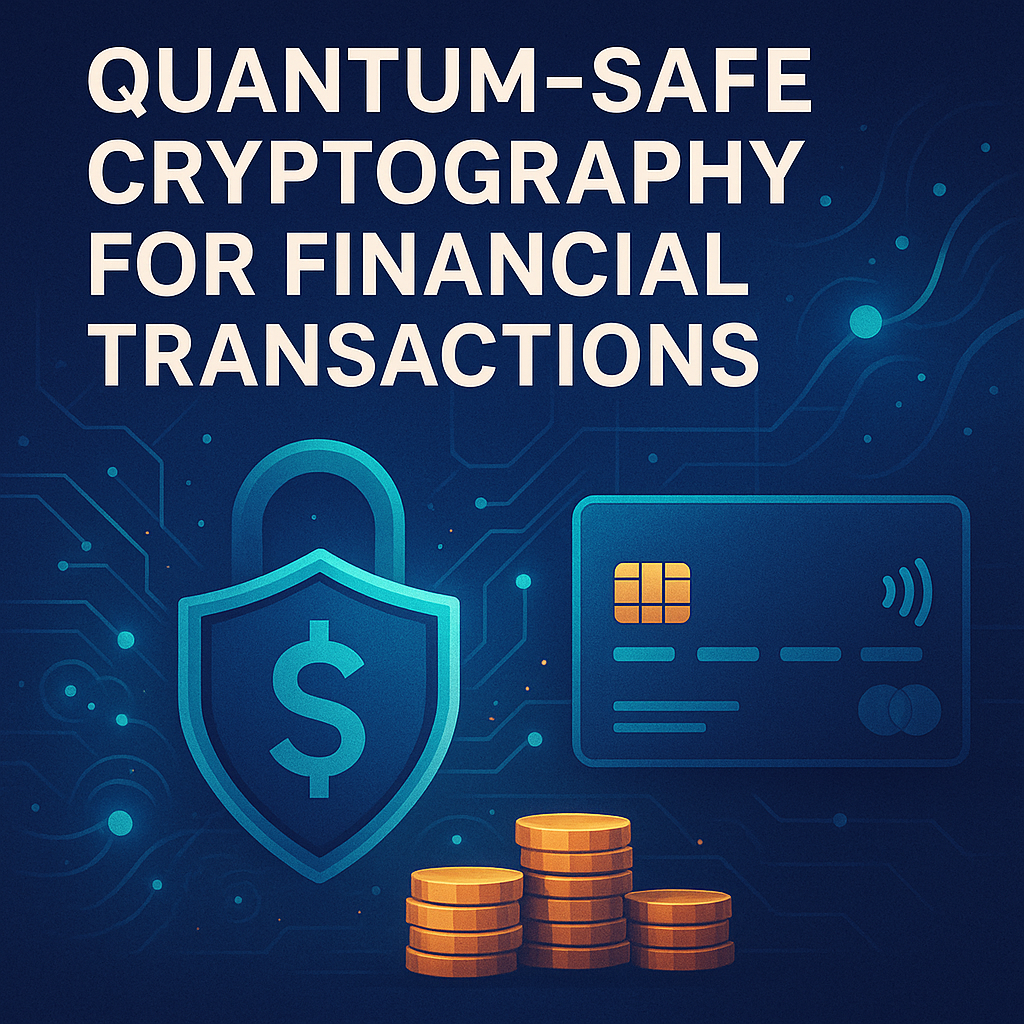
Safeguarding the Future of Digital Finance
Introduction
In the digital age, security is paramount. As financial transactions increasingly shift to online platforms, mobile banking apps, digital wallets, and decentralized finance (DeFi) ecosystems, the demand for robust cybersecurity measures has never been greater. The financial sector depends on encryption technologies to protect everything from credit card information and investment data to cross-border transfers and personal communication.
But a looming technological revolution threatens to upend the security foundations upon which modern finance is built: quantum computing.
Quantum computers, still in their developmental stages, promise unprecedented processing power. However, that power also presents a risk: many of today’s encryption systems, designed for classical computers, could be broken in seconds by sufficiently powerful quantum machines. The solution? Quantum-safe cryptography—a field dedicated to building quantum-resistant algorithms that can protect financial data and communication well into the quantum era.
At Savings UK Ltd, we believe that preparing for a quantum future is not just a technological imperative, but a strategic financial one. In this article, we explore what quantum-safe cryptography means for the financial sector, its implications for digital security, and the actions that institutions and individuals can take now.
The Current State of Encryption in Finance
Modern financial systems rely heavily on public-key cryptography to secure transactions and communications. The most widely used algorithms—RSA, ECC (Elliptic Curve Cryptography), and Diffie-Hellman—depend on the computational difficulty of solving certain mathematical problems, such as factoring large numbers or solving discrete logarithms.
These cryptographic protocols are used to:
-
Secure web traffic via HTTPS
-
Authenticate users on digital banking platforms
-
Protect private keys in digital wallets
-
Enable secure messaging between clients and financial institutions
-
Safeguard financial records and transaction logs
While these systems are extremely robust against classical computers, they are vulnerable to Shor’s Algorithm—a quantum algorithm capable of cracking RSA and ECC encryption exponentially faster than classical methods.
If quantum computers become operational at scale, current encryption could be rendered obsolete. The financial consequences would be enormous, ranging from mass data breaches to systemic threats across the global banking infrastructure.
Quantum Threat Timeline: Sooner Than Expected?
There is a misconception that quantum computing is decades away. In truth, significant milestones are already being achieved:
-
Google demonstrated quantum supremacy in 2019.
-
IBM, Intel, and Honeywell have launched roadmaps for quantum processors with over 1,000 qubits in the next few years.
-
Governments are investing billions into quantum research; the UK’s National Quantum Technologies Programme is a major player.
Experts estimate that a quantum computer capable of breaking RSA-2048 could emerge within 10–20 years—or even sooner. Given the long lead times involved in overhauling cybersecurity systems, financial institutions must begin the transition to quantum-safe encryption today to avoid a security crisis tomorrow.
What Is Quantum-Safe Cryptography?
Quantum-safe (or post-quantum) cryptography refers to cryptographic algorithms that are secure against both classical and quantum attacks. These algorithms rely on mathematical problems that are not easily solvable—even with a quantum computer.
Examples include:
-
Lattice-based cryptography: Hard problems like Learning With Errors (LWE).
-
Code-based cryptography: Based on decoding random linear codes.
-
Hash-based signatures: Such as XMSS and SPHINCS+.
-
Multivariate polynomial cryptography: Involving systems of equations over finite fields.
These algorithms form the foundation of NIST’s ongoing Post-Quantum Cryptography Standardization Project, which is developing the next generation of secure encryption protocols.
Applications in Financial Transactions
Quantum-safe cryptography will need to be integrated into every layer of financial infrastructure:
1. Digital Wallets and Blockchain Systems
Private keys used in cryptocurrencies and blockchain-based payment systems are vulnerable to quantum attacks. Quantum-resistant key schemes must be embedded into wallets, exchanges, and DeFi platforms to prevent key theft or double-spending.
2. Secure Messaging Between Financial Entities
Secure messaging services like SWIFT or financial APIs must transition to quantum-resistant authentication methods to ensure that sensitive communications cannot be intercepted or forged by quantum adversaries.
3. Banking Apps and Online Portals
From login authentication to encrypted data storage, consumer-facing applications will need to adopt quantum-safe protocols that can withstand next-generation threats without sacrificing user experience.
4. Cross-Border Transactions and Clearing Houses
Financial institutions that process large volumes of transactions across jurisdictions must ensure that their encryption protocols remain effective regardless of regulatory environment or technological disparity.
5. Long-Term Data Protection
Financial documents, contracts, and personal client information archived today may still be relevant a decade from now. This creates a risk known as “harvest now, decrypt later,” where attackers store encrypted data now in the hope of decrypting it with future quantum technology.
Challenges and Implementation Barriers
Transitioning to quantum-safe cryptography is not as simple as flipping a switch. It involves:
-
Scalability and performance: Some post-quantum algorithms require larger key sizes or more computational resources.
-
Interoperability: Ensuring new systems work with existing infrastructure and global financial standards.
-
Standardization: Waiting for finalized algorithms from NIST or ISO can delay adoption.
-
Legacy systems: Banks and institutions often rely on outdated systems that are difficult to upgrade.
To overcome these hurdles, Savings UK Ltd encourages a phased transition strategy, beginning with quantum risk assessments and pilot programs that test hybrid cryptographic systems—those that use both classical and quantum-safe algorithms in parallel.
Regulatory and Industry Action
Governments and industry groups are increasingly aware of the quantum threat:
-
The U.S. Cybersecurity and Infrastructure Security Agency (CISA) has issued guidelines for quantum readiness.
-
The European Union Agency for Cybersecurity (ENISA) has called for coordinated quantum migration plans.
-
The Bank of England and FCA have conducted quantum risk reviews in the context of UK financial stability.
At the corporate level, major banks and fintech firms are beginning to invest in quantum R&D and post-quantum cryptographic (PQC) integration projects. Companies like Mastercard, JPMorgan, and IBM have formed quantum working groups to explore early implementation.
Financial Implications and Strategic Planning
From a financial perspective, investing in quantum-safe technology now is more cost-effective than responding to a breach later. Key considerations include:
-
Reputational Risk: A data breach due to outdated encryption can result in customer distrust, lost clients, and regulatory fines.
-
Compliance Risk: As quantum-security regulations evolve, institutions must ensure they remain compliant or risk exclusion from certain markets.
-
Competitive Advantage: Firms that proactively adopt quantum-resilient systems can position themselves as leaders in security and innovation.
At Savings UK Ltd, we help institutions and individuals assess their exposure to quantum vulnerabilities and build secure, future-proof financial strategies.
Steps Toward Quantum Readiness
Here are five practical steps financial organizations and investors should consider:
-
Conduct a Quantum Risk Audit
-
Identify all systems that rely on vulnerable encryption.
-
Evaluate the shelf-life of stored sensitive data.
-
-
Engage with Post-Quantum Standards
-
Monitor NIST developments and incorporate finalists into internal roadmaps.
-
Use hybrid cryptography where appropriate.
-
-
Collaborate Across the Ecosystem
-
Work with vendors, payment processors, and partners to align quantum transition efforts.
-
-
Educate Staff and Clients
-
Build awareness of quantum threats and solutions among technical and non-technical stakeholders.
-
-
Invest in Quantum-Safe Startups
-
Venture investments in cybersecurity startups developing quantum-resistant solutions can offer both protection and returns.
-
Conclusion
Quantum computing represents both a technological leap forward and a looming threat to traditional cybersecurity systems. For the financial sector, the risk is existential—but so is the opportunity. By adopting quantum-safe cryptography, banks, fintech firms, and investors can safeguard the integrity of financial transactions, digital wallets, and secure messaging systems against future attacks.
At Savings UK Ltd, we view quantum readiness as a vital pillar of 21st-century financial planning. The cost of inaction is high—but the rewards of early adoption include resilience, trust, and market leadership.

Quantum-safe cryptography is becoming a strategic priority for the financial sector. With the rapid progress in quantum computing, current encryption standards like RSA and ECC could be broken in the foreseeable future, exposing sensitive transaction data and customer records. The transition to post-quantum algorithms should start now, not when the threat becomes imminent. Financial institutions that adopt quantum-safe solutions early… Read more »
For financial institutions, quantum-safe cryptography is not just about security—it’s about future-proofing infrastructure. Quantum computing could make today’s encryption vulnerable within a decade, meaning that long-term data stored today could be decrypted in the future. This “harvest now, decrypt later” risk is especially concerning for high-value financial data. Transitioning to quantum-resistant algorithms such as lattice-based cryptography will require careful planning,… Read more »
The urgency around quantum-safe cryptography cannot be overstated. Financial transactions depend on cryptographic protocols that quantum computing could render obsolete. The cost of being unprepared could be catastrophic, both financially and reputationally. I see a strong case for integrating post-quantum encryption into payment systems, interbank transfers, and blockchain-based settlement layers now, even if quantum threats are still theoretical for most.… Read more »